Short answer: Visit at least two of the contractor's running sites and one finished house, talk to those owners without the thekedaar standing next to you, insist on an itemised written quote, and never pay more than 10% as advance. If a contractor resists any of this, that tells you everything.
Every family in Delhi has a thekedaar story
Ask around your colony and you will hear them. The thekedaar who took ₹5 lakh advance and stopped picking up the phone. The one who used 8 mm sariya where the drawing said 12 mm. The one who finished the slab beautifully and then disappeared for three months during finishing because he had picked up a bigger job in Gurgaon.
Most thekedaars are not crooks. Many are skilled, hardworking people who learned on site, not in a college. The trouble is that good and bad contractors look exactly the same in the first meeting. Both will say "Aap tension mat lo, sab ho jayega." Your job is to find out who actually means it.
We come from a family that has been building homes in Delhi for decades, and we have hired, fired and re-hired more contractors than we can count. This is the checklist we wish every homeowner had before signing.
Step 1: Shortlist from work, not from visiting cards
The best leads come from houses you have actually seen. If a new building in your colony looks well finished, stop and ask the owner who built it. Neighbourhood WhatsApp groups and RWA contacts are also more reliable than random online listings.
Shortlist three contractors. One is too few to compare, and more than four wastes everyone's time.
Step 2: Visit a running site, unannounced if you can
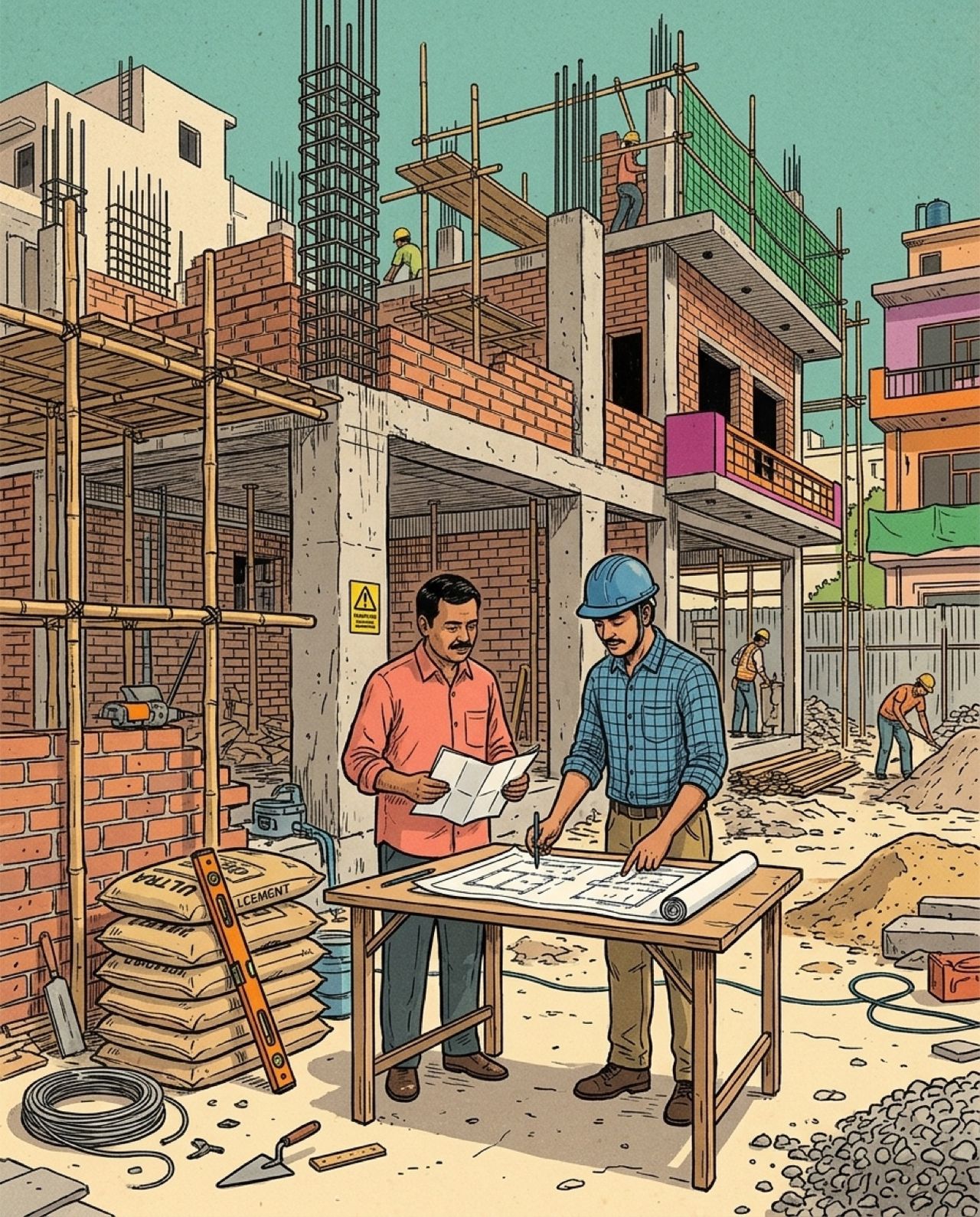
A finished house shows you the final paint. A running site shows you the truth. Look for:
- Is material stored properly? Cement bags stacked on a platform and covered, not lying on wet ground. Sariya kept off the soil so it does not rust.
- Is the site clean and organised? A messy site usually means messy supervision.
- Curing. Fresh slabs and columns should be kept wet for days. Dry, cracked concrete means someone is skipping curing to save time.
- Shuttering quality. Warped plywood and gaps in shuttering lead to honeycombing in concrete.
- Is the mistri or supervisor actually present? Or is the site left to a couple of helpers?
Step 3: Ask these 10 questions before you hire
- How many sites are you running right now? More than three or four for a small contractor usually means yours will wait.
- Who will be on my site every day? Get the name and number of the site supervisor or head mistri, not just the owner.
- Can I speak to two clients from the last two years? Call them, and ask what went wrong, not just what went right.
- Is this a labour rate or a material sahit rate? And exactly which items are included?
- Which brands will you use for cement, sariya, wiring and pipes? Get it in writing.
- What concrete grade and steel sizes will you follow? The right answer is "as per the structural drawing". If he says "we will see on site", be careful.
- How will you handle curing, waterproofing and testing? Ask if he does cube tests for concrete on larger jobs.
- What is the payment schedule? It should be tied to stages of work, not dates.
- What is the timeline, and what happens if it slips? A good contractor will agree to a reasonable delay clause.
- What warranty do you give on waterproofing and plumbing leaks? Even a one-year defect period tells you he is confident in his work.
8 red flags: walk away if you see these
- He wants a big advance. Anything above 10% before work starts is a warning sign. "Material lana hai" is not a reason to hand over ₹5 lakh on day one.
- His quote is far cheaper than everyone else's. If two contractors say ₹2,400 and he says ₹1,800, the missing ₹600 will come out of your steel, your cement or your waterproofing.
- He refuses a written agreement. "Hum zubaan ke pakke hain" sounds nice until there is a dispute.
- He will not let you speak to old clients alone.
- He dismisses drawings. "Architect ki drawing ki zaroorat nahi, humne bahut ghar banaye hain." Experience is valuable. Ignoring a structural design is not.
- He pushes cash-only payments with no receipts. You lose all proof of what you paid and when.
- He changes the scope after signing. Items that were "included" suddenly become "extra" once the slab is cast and you cannot easily switch contractors.
- He cannot name his site supervisor. It means he plans to manage your site on the phone.
A fair payment schedule (tied to work, not dates)
Never pay by calendar. Pay when a stage is complete and checked. A typical structure for a full construction contract looks like this:
| Stage | Payment |
|---|---|
| Signing and mobilisation | 5 to 10% |
| Foundation and plinth complete | 10 to 15% |
| Each slab cast (split across floors) | 25 to 35% in total |
| Brickwork and plaster complete | 15 to 20% |
| Flooring, electrical and plumbing | 10 to 15% |
| Painting and final finishing | 5 to 10% |
| Retention, released after the defect period | 5% |
The retention amount matters more than people think. Holding back 5% for three to six months after handover is the simplest way to make sure leaks and cracks actually get fixed.
What your contract must say
You do not need a 40-page legal document. You do need these points on paper, signed by both sides:
- Scope of work, item by item, with what is included and what is not.
- Rates, either per sq ft or per item, and whether GST is included.
- Material specifications: brands and grades of cement, steel, bricks, pipes, wires, tiles and sanitaryware.
- Drawings that the work will follow, attached as an annexure.
- Timeline with stage-wise target dates.
- Payment schedule linked to stages, plus the retention clause.
- Delay clause: what happens if the work runs late without a valid reason.
- Defect liability period for leaks, cracks and plumbing.
- Site safety and labour responsibility stays with the contractor.
- Exit clause: how either side can end the contract and how pending work is measured and paid.
Frequently asked questions
How do I verify a contractor in Delhi? See his past and current sites, call at least two previous clients directly, check that he has a GST number if he is billing material, and ask for his PAN and Aadhaar for your records.
Should I hire a contractor or a builder? A builder usually builds for sale and adds a profit margin on top of construction. If you are building your own home, hiring a contractor directly, with proper design and supervision, keeps you in control and saves that margin.
What advance should I pay a thekedaar? No more than 5 to 10% of the contract value at the start, and only against a signed agreement.
Can I change my contractor midway? Yes, but it is painful and expensive. A clear exit clause and stage-wise measurements make it much easier if you ever need to.
Why ThekeYaar is not your usual thekedaar
Everything on this checklist is work. Visiting sites, calling references, reading quotes, checking steel. Most families do not have the time, and frankly they should not have to.
That is the job we took on. Every contractor on ThekeYaar is background checked on past work and trained on our architectural standards before getting a single client. A trained ThekeYaar coordinator becomes your one point of contact, so you are not chasing five different people. You can see your site's progress, with photos and timelines, right from your phone. And you get contractors at the same rates they offer builders, with zero design fees from our in-house architects.
Your home should feel like yours. Not like something you survived.