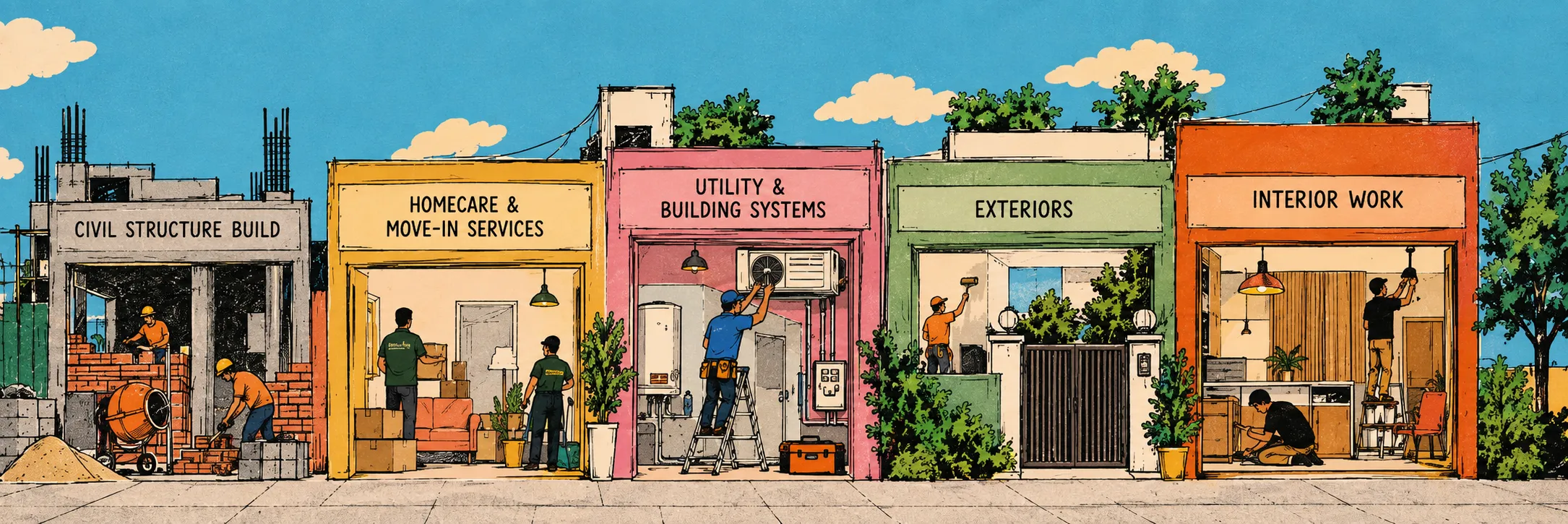
Short answer: In 2026, building a house in Delhi NCR costs roughly ₹1,700 to ₹2,200 per sq ft for a basic build, ₹2,200 to ₹3,200 for a standard family home, and ₹3,200 to ₹4,500+ for premium finishes. So a standard 1,000 sq ft floor lands somewhere around ₹22 to ₹32 lakh, before interiors. The rest of this post explains why your number could be higher or lower, and where most families get caught off guard.
Why the per sq ft number confuses everyone
Ask five thekedaars in Delhi what it costs to build a ghar, and you will get five different answers. One says ₹1,600 per foot. Another says ₹2,800. A third just says "Bhaiya, site dekh ke batayenge."
They are not all lying. They are quoting different things.
One rate might cover only the grey structure: foundation, columns, slab, brickwork and plaster. Another might include flooring, bathrooms, wiring and paint. A third might be a labour-only rate where you buy the cement and sariya yourself. Until you know what a rate includes, comparing two quotes is like comparing a thali price with a roti price.
Our family has been building homes, builder floors and farmhouses in Delhi for decades. The single most common mistake we have seen is not a bad contractor. It is a family that budgeted for the structure and forgot that finishing eats almost as much money again.
House construction cost per sq ft in Delhi NCR (2026)
These are realistic, on-ground ranges for a full build (structure plus standard finishing), excluding land, interiors and approvals.
| Build quality | Cost per sq ft | What you typically get |
|---|---|---|
| Basic | ₹1,700 to ₹2,200 | Local-brand fittings, standard vitrified tiles, simple paint, basic electrical layout |
| Standard | ₹2,200 to ₹3,200 | Branded sanitaryware and wiring, better tiles, granite kitchen top, putty and emulsion paint |
| Premium | ₹3,200 to ₹4,500 | Marble or large-format tiles, concealed cisterns, false ceilings, designer elevation |
| Luxury | ₹4,500 and above | Italian marble, VRV or ducted AC, home automation, lift, custom facade |
Location inside NCR also matters. Building in a tight South Delhi lane, where material has to be offloaded at night and carried in by hand, costs more than an open plot in Noida or Faridabad. Expect South and Central Delhi to sit at the top of each range.
Built-up area, carpet area and gaj: get this right first
Contractors quote per sq ft of built-up area (also called covered area), which includes walls, staircase and balconies. Your carpet area is the usable floor inside the walls and is always smaller, often by 20 to 30%.
In Delhi, plots are still spoken of in gaj (square yards). One gaj is 9 sq ft, so a 100 gaj plot is 900 sq ft of land. But you build on multiple floors, so your built-up area can be several times your plot size. When a contractor gives you a total, always ask: "Yeh kitne sq ft ka rate hai, aur kaunsa area count kiya hai?"
Total budget by size: 1,000, 1,500, 2,000 and 3,000 sq ft
Multiply your built-up area by the rate and you get a starting budget. Here is what that looks like for the sizes we see most often in Delhi NCR.
| Built-up area | Basic | Standard | Premium |
|---|---|---|---|
| 1,000 sq ft (single floor, 2BHK or small 3BHK) | ₹17 to ₹22 lakh | ₹22 to ₹32 lakh | ₹32 to ₹45 lakh |
| 1,500 sq ft (G+1 or large builder floor) | ₹25 to ₹33 lakh | ₹33 to ₹48 lakh | ₹48 to ₹68 lakh |
| 2,000 sq ft (independent house) | ₹34 to ₹44 lakh | ₹44 to ₹64 lakh | ₹64 to ₹90 lakh |
| 3,000 sq ft (G+2 or kothi) | ₹51 to ₹66 lakh | ₹66 to ₹96 lakh | ₹96 lakh to ₹1.35 crore |
These are construction numbers only. Land, modular kitchen, wardrobes, ACs and furniture come on top.
How the type of house changes the rate
Builder floor or independent house. The standard Delhi format: stilt parking, then one family per floor or the whole building for one joint family. Costs follow the table above. Each extra floor adds a slab, a staircase flight and more steel, but foundation cost gets shared across floors, so per sq ft rates stay fairly steady.
Duplex. Double-height living rooms, internal staircases and bigger windows mean more RCC, more shuttering and more skilled labour. Expect a duplex to cost 10 to 20% more per sq ft than a regular floor of the same finish.
Villa or farmhouse. Large spans, big glass, landscaping, pools and boundary walls push most villas into the premium and luxury bands. Rates of ₹4,500 to ₹8,000 per sq ft are normal here.
Basement. Very popular in South Delhi for parking and extra rooms, and very easy to underestimate. Digging, shoring, retaining walls, soil disposal and serious waterproofing can raise the total project cost by a fifth to a third. Never let anyone build a tehkhana without proper waterproofing design. Seepage in a basement is a lifelong headache.
Where your money actually goes
For a standard family home, this is roughly how the construction budget splits:
| Head | Share of budget | What is inside |
|---|---|---|
| Structure (RCC, foundation, brickwork, plaster) | 35 to 45% | Footings, columns, beams, slabs, walls |
| Finishing | 20 to 25% | Paint, doors, windows, railings, bathroom fittings |
| Electrical and plumbing | 10 to 15% | Wiring, switches, DB, CPVC and SWR pipes, tanks |
| Flooring and tiling | 8 to 12% | Floor tiles or marble, bathroom and kitchen dado |
| Approvals, supervision and miscellaneous | 5 to 10% | Plan sanction, temporary connections, debris, water |
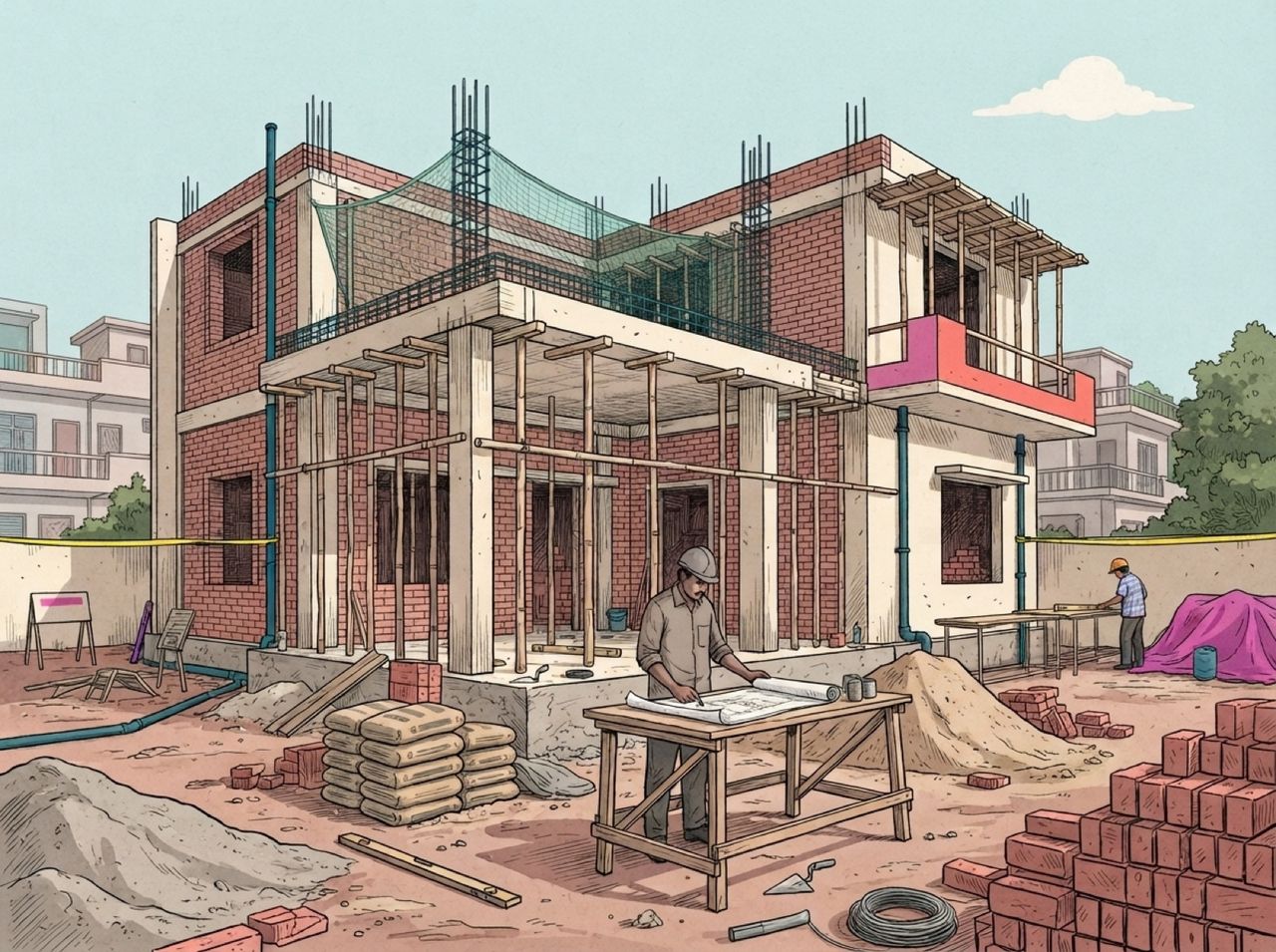
Notice that structure is less than half. This is exactly why a contractor's "structure rate" of ₹1,400 per sq ft does not mean your house will cost ₹1,400 per sq ft.
Material rates in Delhi NCR right now
Material is 50 to 60% of what you spend. These are indicative dealer-to-retail prices from mid-2026. Rates move every few weeks, so always take two or three quotes from your local dealer before you place an order.
| Material | Typical price |
|---|---|
| Cement, PPC (50 kg bag) | ₹385 to ₹430 |
| Cement, OPC 43 grade (50 kg bag) | ₹405 to ₹450 |
| TMT sariya, Fe500D | ₹59 to ₹68 per kg (branded bars cost a few rupees more) |
| Red clay bricks (eent) | ₹7 to ₹9 each |
| Fly ash bricks | ₹6 to ₹8 each |
| AAC blocks (600 x 200 x 200 mm) | ₹47 to ₹58 each |
| River sand (reta) | ₹2,600 to ₹3,300 per tonne |
| M-sand | ₹1,800 to ₹2,400 per tonne |
| Aggregate, 20 mm (rodi) | ₹1,300 to ₹1,770 per tonne |
| Vitrified tiles (2 x 2 ft) | ₹60 to ₹110 per sq ft |
A rough thumb rule for a framed house: about 3.5 to 4 kg of steel and about half a bag of cement per sq ft of built-up area. So a 1,500 sq ft house will use somewhere around 5 to 6 tonnes of sariya. A ₹5 per kg jump in steel during construction adds ₹25,000 to ₹30,000 to your bill, just like that.
Labour cost
Labour usually makes up 20 to 30% of the total. If you hire on a labour rate theka (you buy material, the contractor brings the mistri and beldar), Delhi NCR rates for the grey structure typically run ₹300 to ₹500 per sq ft. Finishing trades like tiling, painting, plumbing and electrical are often charged separately, per sq ft or per point. We have written a full comparison of labour vs material contracts if you are deciding between the two.
Hidden costs nobody mentions in the first meeting
These are the items that turn a ₹40 lakh plan into a ₹52 lakh reality. None of them are dramatic on their own. Together, they hurt.
- Architect and structural design fees. Most architects in Delhi charge 3 to 8% of the project cost for full drawings and site visits. On a ₹50 lakh build, that is ₹1.5 to ₹4 lakh.
- Plan sanction and approval charges. Fees, architect filing charges and the time it takes.
- Soil testing. Small cost, big consequences if skipped, especially near the Yamuna belt or on filled land.
- Malba (debris) removal. If you are rebuilding an old house, demolition and carting away rubble is a real line item.
- Temporary bijli and paani connections for the construction period.
- Waterproofing. Terrace, bathrooms, sunken areas and the basement. Cheap waterproofing is the most expensive mistake you can make.
- Boundary wall, main gate, ramp and grills. Often left out of the per sq ft rate.
- Price escalation. A 12 to 15 month build will see steel and cement prices move. Budget for it.
- Rent. If your family is moving out while the old house comes down, a year of rent belongs in the budget too.
As a rule, keep 10% of your total budget as contingency. If you do not need it, it becomes your furniture fund.
How long does it take?
A simple single floor of 1,000 sq ft takes about 6 to 9 months. A G+1 takes 9 to 12 months, and a G+2 independent house usually 12 to 16 months. Monsoon (July to September) slows down slab work and plaster, so a project started in March often finishes faster than one started in June.
Five ways to save money without cutting corners
- Freeze the design before the first brick. Every change mid-way means breaking something that is already built. Tod-phod is pure waste.
- Do not save on structure or waterproofing. Save on things you can upgrade later, like light fittings or a feature wall.
- Buy cement and steel in planned lots, not in panic when the slab is due. Rushed buying is expensive buying.
- Get an itemised quote. A single lump-sum number hides where the margin is. Item-wise rates let you compare honestly.
- Avoid stacked commissions. In many projects the designer takes a cut on materials, the contractor adds a markup, and the dealer adds his. Pay for work, not for middlemen.
Frequently asked questions
What is the construction cost per sq ft in Delhi in 2026? For a full build excluding interiors, plan for ₹1,700 to ₹2,200 per sq ft for basic quality, ₹2,200 to ₹3,200 for standard, and ₹3,200 to ₹4,500+ for premium.
How much does it cost to build a 100 gaj house in Delhi? It depends on how many floors you build. For example, if you build three floors of about 800 sq ft each (2,400 sq ft), a standard finish would be roughly ₹53 to ₹77 lakh. Check what your plot is allowed under current building rules before you plan floors.
Is labour contract cheaper than a full contract? On paper, usually yes. In practice, it depends on whether you can visit the site almost daily, buy material smartly and control wastage. If you cannot, a material contract often ends up cheaper and less stressful.
Does the per sq ft rate include interiors? Almost never. Modular kitchen, wardrobes, false ceiling and lighting are usually quoted separately.
Kya per sq ft rate mein GST included hota hai? Ask this every single time. Some quotes include it, many do not, and that difference can be significant on a large project.
Get your exact number
Ranges are a starting point. Your plot, your floors and your choice of tiles decide the real figure. Use the ThekeYaar construction cost calculator to get a budget, standard and premium estimate for your exact location and area in under two minutes.
And if you want to cut a few lakhs out of that number without cutting quality: with ThekeYaar you pay zero design fees, because our in-house architects and engineers work with you for free, and no builder markups, because you get vetted contractors at the same rates they give builders.
It is your home, not a builder's project. Build it that way.