To read a construction quotation properly, check six things before the final number: the exact scope of work, whether it is labour-only or labour plus material, the material brands and specifications, the quantities, units and rates, what is excluded, and the payment terms. Two quotes can only be compared when they cover the same work. The cheapest quote is often the one that leaves the most out.

Introduction: A Quotation Is More Than Just a Number
You call three contractors for the same work. One quotes ₹2 lakh, the second ₹2.4 lakh and the third ₹2.7 lakh. Easy decision, right?
Not quite. What if the first one has quoted only labour, the second has included material, and the third has added surface preparation and debris removal that the other two quietly left out? Suddenly the “cheapest” quote may not be cheap at all.
This is where most Delhi homeowners get caught. A quotation is not just a final price. It is a breakdown of the work, materials, quantities, rates and responsibilities on your project. Read it properly and you know exactly what you are paying for. Skim it and you find out halfway through the job, usually when the contractor says, “Yeh toh quote mein tha hi nahi.”
Here is a practical, step-by-step guide to reading and comparing construction quotations like someone who has done it before.
1. Start by Understanding the Scope of Work
The first question is simple: what exactly has the contractor agreed to do? A good quotation describes every activity included in the work, not just the name of the job.
Take a flooring quote. It should clearly say:
- Whether it covers only tile laying or also preparing the floor.
- Whether tile adhesive or cement mortar is included.
- Whether skirting is included.
- Whether cutting, edge finishing and wastage are accounted for.
- Whether the rate covers only labour or material as well.
The same applies to every trade, from excavation and RCC to plastering, electrical work and painting.
Remember: Two quotations are not comparable if they cover different scopes of work.
2. Check Whether the Quotation Is Labour-Only or Labour + Material
This one detail changes everything, and it is the most common reason quotes look wildly different.
Labour-only quotation: The contractor provides the workers and does the job. You arrange the materials.
Labour + material quotation: The contractor provides both the labour and the specified materials to complete the work.
Material-only quotation: A supplier or contractor quotes only for materials, and installation is arranged separately.
Always confirm which one you are looking at before comparing prices. A contractor quoting ₹80 per sq ft for tile laying on a labour-only basis cannot be compared with another quoting ₹150 per sq ft including tiles. The lower number does not mean the work is cheaper.
3. Understand the Materials Being Used
When materials are included, never accept vague words like “cement”, “steel”, “tiles” or “good quality fittings”. “Achha wala lagayenge” is not a specification.
Ask for details such as:
- Brand and grade of cement.
- Brand and grade of steel.
- Type and specification of bricks or blocks.
- Tile size, brand and quality.
- Paint brand, product range and finish.
- Electrical wire brand and specification.
- Plumbing pipe brand and material type.
Wherever the brand or specification makes a real difference, get it in writing.
If you are buying materials yourself, make sure the quotation clearly states that material is excluded. That way you can compare suppliers separately and know exactly what the contractor is charging for.
4. Look at Quantities, Units and Rates
A good quotation lets you see how the final amount was calculated. Look for three things on every line:
Quantity: How much work is being counted?
Unit: How is the work being measured?
Rate: What is the price per unit?
Here are the common units used in house construction:
Work
Common measurement unit
Excavation
Cubic feet or cubic metres
RCC work
Cubic feet or cubic metres
Brickwork
Cubic feet or square metres
Plastering
Square feet or square metres
Flooring
Square feet
Painting
Square feet
Electrical points
Per point
Plumbing work
Per point or item
A clear line item looks like this:
Description
Quantity
Rate
Amount
Floor tile installation
1,000 sq ft
₹60
₹60,000
With quantity, unit and rate in front of you, it is much easier to judge whether the amount is reasonable for the work.
Also check whether the quantities are estimates or based on actual site measurements. Final quantities can change with site conditions and drawings, so agree on how the work will be measured at the end.
5. Check What Is Excluded
Very often, the most important part of a quotation is what it does not include. You assume something is covered, the contractor assumes it is not, and the argument starts mid-way.
A painting quote, for example, may exclude:
- Wall putty.
- Surface preparation.
- Primer.
- Additional coats.
- Scaffolding.
- Repair of damaged plaster.
An electrical quote may leave out switches, fixtures, wiring or the installation of decorative lights.
Ask every contractor to list exclusions clearly. It is the easiest way to avoid surprise bills once the work has started.
6. Look for Additional Charges and Conditions
Before you say yes, check for any extra costs or conditions hiding in the fine print. Clarify:
- Transportation and material unloading.
- Debris removal and malba disposal.
- Scaffolding and equipment charges.
- Site cleaning.
- Taxes, where applicable.
- Charges for additional work and variations.
- Price changes if material specifications change.
- Charges for work outside the agreed scope.
Not every quote will have all of these. What matters is knowing which ones apply to your project before work begins.
7. Understand the Payment Schedule
“Payment ka baad mein dekh lenge” is never a good sign. A quotation should explain when and how you will pay.
Clarify:
- Advance payment, if any.
- Payments linked to work milestones.
- Payments for material purchases.
- How completed work will be measured and verified.
- Final payment after completion.
- Conditions for any additional payments.
For bigger jobs, milestone-based payments keep your money tied to actual progress. Keep a record of every payment and every agreed change.
8. Compare Multiple Quotations Properly
Getting multiple quotes is smart. Comparing only the final totals is not. Look at this example:
Particulars
Contractor A
Contractor B
Quoted amount
₹2,00,000
₹2,35,000
Labour included
Yes
Yes
Materials included
No
Yes
Transportation
Excluded
Included
Surface preparation
Excluded
Included
Contractor A looks ₹35,000 cheaper. But once you add materials, transport and surface preparation, Contractor A may well end up costing more.
Before deciding, bring every quote to the same scope. Compare the same quantities, material specifications, inclusions and exclusions. Only then is the comparison fair.
Also weigh the contractor’s relevant experience, communication, availability and ability to handle your work. The lowest quote is not automatically the best choice.
9. Get Everything Confirmed in Writing
Verbal discussions are useful. Written records are what protect you. Before work begins, make sure these are documented:
- Final scope of work.
- Agreed quantities and rates.
- Material brands and specifications.
- Inclusions and exclusions.
- Payment schedule.
- Expected timeline.
- Process for additional work or changes.
- Responsibilities of the homeowner and the contractor.
If the scope or rates change during construction, record the revised agreement too. A clear written agreement protects both you and the contractor from misunderstandings.
10. Use a Simple Checklist Before Accepting a Quotation
Before you finalise any contractor, run through this list:
- Is the scope of work clearly mentioned?
- Is it labour-only or labour + material?
- Are material brands and specifications mentioned?
- Are quantities and measurement units clear?
- Are rates and total amounts mentioned?
- Are inclusions and exclusions listed?
- Are transportation and additional charges clarified?
- Is the payment schedule agreed?
- Is the expected timeline discussed?
- Are changes and extra work covered in writing?
If any important detail is missing, ask for a revised quotation before you proceed. A good contractor will not mind.
How ThekeYaar Helps Homeowners Make Better Comparisons
Reading one quotation is hard enough. Collecting three for every trade, making sure they cover the same scope and then chasing each contractor for clarifications is where most families give up and just pick the lowest number.
ThekeYaar makes this simpler.
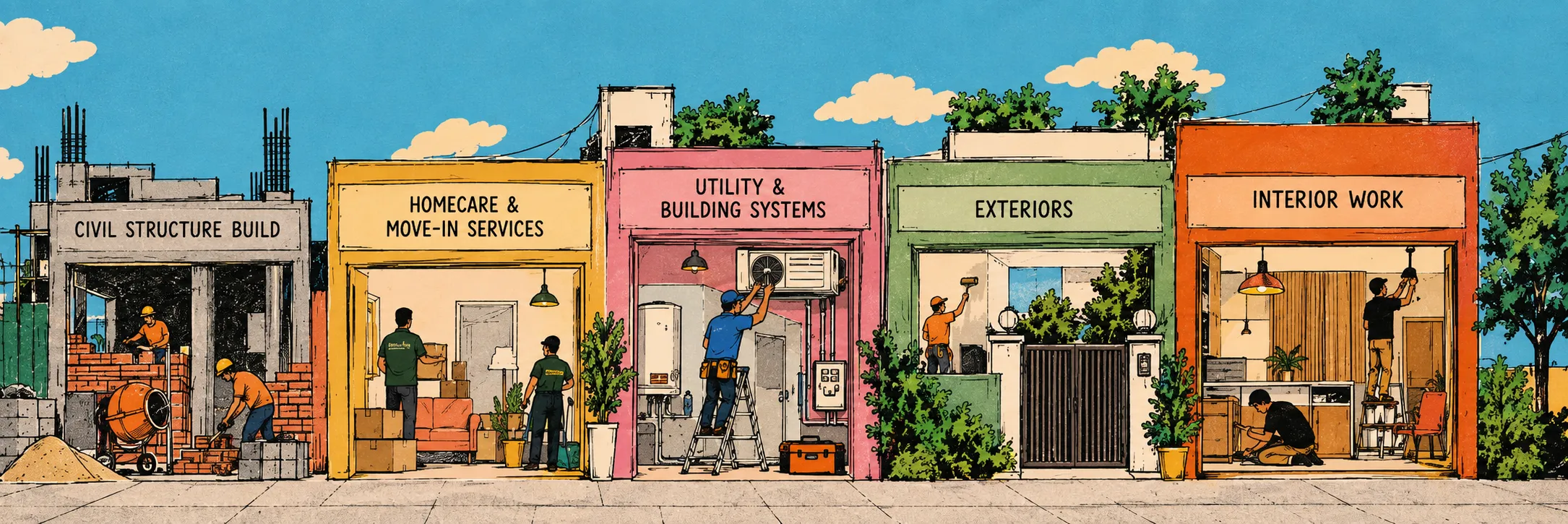
Choice of contractors for every stage. Explore contractors across every construction category, from RCC and masonry to electrical, plumbing, flooring and painting, and compare your options in one place instead of relying on one bundled quote.
Your choice of materials. Choose the brands and specifications you want, with sourcing support, so you always know what material is going into your quote.
Packages for every budget. Pick the combination of quality and price that suits you, instead of fitting your house into one fixed package.
Free architectural support and site supervisors. Get professional guidance on planning and on-site work, so quantities, scope and quality are checked by people who know construction.
A proper, organised process. Contractors, quotations, scopes and progress come together in one structured system, and you can see everything on the website.
You should always know what work is being done, who is doing it and what you are paying for. With ThekeYaar, you do.
Explore contractor options and construction support on ThekeYaar →
Final Thoughts: Understand Before You Agree
A construction quotation can look intimidating the first time, but you do not need to be an engineer to read one.
Start with the scope. Check whether materials are included. Understand the quantities and rates. Read the exclusions. Compare every quote on equal terms. And never finalise a contractor on price alone.
Your home is one of the biggest investments you will make. A little time spent understanding a quotation before you sign saves you confusion, surprise costs and arguments later.
Make informed choices. Build with clarity. Build with ThekeYaar.
Frequently Asked Questions
What should a construction quotation include?
The scope of work, quantities, measurement units, rates, material specifications, total amount, inclusions, exclusions, payment terms and expected timeline.
How many contractor quotations should I compare?
At least two or three for the same scope of work. That gives you a clear sense of market rates and how the proposed work differs.
What is the difference between labour-only and labour + material quotations?
A labour-only quote covers workers and execution, while a labour + material quote covers both labour and the specified materials. Always confirm exact responsibilities in writing.
Should I always choose the lowest construction quotation?
No. A lower quote may leave out materials, related activities or other costs. Compare the full scope, specifications and terms before deciding.
Can I negotiate a contractor’s quotation?
Yes. You can discuss rates, quantities, material specifications and scope with the contractor. Record any agreed changes in writing.
What should I do if a contractor gives only a lump-sum quotation?
Ask for a detailed breakdown. Get clarity on the work included, materials, quantities, exclusions and payment terms before accepting it.
How can ThekeYaar help me find contractors?
ThekeYaar lets you explore and compare contractors across every construction category, choose your materials with sourcing support and pick a package that fits your budget. You also get free architectural support and site supervisors, with everything visible on the website.